It is important to take care of your trees during hurricane season. I would recommend looking around your property and making sure there are no broken limbs, deadwood, or canopies that need to be pruned due to balance and access growth. Pruning out your trees greatly reduces all your chances of possible damage. Here is a link that I found that makes good points for taking care of trees:
http://miami-dade.ifas.ufl.edu/pdfs/disaster/Give%20Tips%20on%20Preparing%20your%20Trees%20for%20Hurricane%20Season.pdf
You can give us a call at 281-914-7788 if you need further questions on your trees.

Helping customers understand trees, plants, and fertilization in the Urban Forest!
Saturday, June 30, 2012


Friday, June 29, 2012
Your Lawn
- Pick Up a Rake and Make Those Dead Leaves Covering Your Lawn Disappear. Leaves left on your lawn will lock out the light and air. A thick layer of leaves can actually smother your lawn.
- Give Your Lawn a Good Last Mow. Once your grass becomes dormant, you can lower your cutting height to one inch for warm-season grasses and two inches for cool-season grasses. Leaving your lawn longer than two inches may trap moisture, setting the stage for diseases to develop in the spring.
- For Your Final Mowing of the Season, It's Okay to Leave a Little Mulch. Leave clippings and leaves on your lawn; not a blanket, just a sprinkling. Mulch can return nitrogen back into the soil over the winter and spring.
- Give Your Lawn Some Breathing Room. Your lawn may have become impacted over the summer with heavy use. This can restrict movement of air and water, and any lawn fertilizer you apply won't be able to penetrate the soil if it's compacted. Aerating your lawn in late fall will give it a chance to breathe. You can rent a good aerating tool for about $100.00, or you can pay a lawn maintenance service to do it for you for about the same price, without the hard work (still hard work, but for someone else).
- If You Still Have Sparse Patches by Winter, Seed Bare Areas. Cooler weather will allow the seeds to germinate without weeds encroaching. Aeration will improve germination. Your lawn should fill in before the ground freezes.
- Your Lawn Has Had a Summer and Fall to Accumulate Dead Grass, Roots, and Other Debris Known As Thatch. This stuff usually accumulates between the blades and sod, and can keep air and water from reaching the soil. There are good de- thatching tools available for this task, or you can have a lawn maintenance service do this for you, as well.
- To Strengthen Your Lawn and Prepare it for its Debut in Spring, Apply a Sustained-Release Nitrogen Lawn Fertilizer by Mid-to-late November. Just because your lawn is asleep, doesn't mean it should be starved. With cooler soil, nutrients break down slower. You want to use a sustained-release product to be sure your lawn gets the nitrogen it needs as well as the phosphorous, potassium, and partially blended sulfate required for quicker green-up in the spring. There is a Scotts fertilizer made especially for winterizing. Use a fertilizer spreader for even results.
- Give Your Lawn One Last Good Dose of Water. This will help activate the lawn fertilizer.
- Drain Your Sprinkler Lines and Close Down Your System. This will avoid the heartache of a frozen, and therefore broken, water pipe. In the event of a dry winter, use your garden hose to give a light sprinkling to your lawn every three weeks or so, just enough to keep it moist.
- While Your Lawn Becomes Dormant, Weeds Still Have a Funny Way of Cropping Up. If this is a problem, apply a broad leaf weed control product to your lawn. Grab weeds as they crop up whenever possible throughout the winter.
Thursday, June 28, 2012
The Fastest Growing Trees!
 The Fastest Growing Trees to Plant!
The popular trees are today's fastest growing trees! Fast growing trees give homeowners the opportunity to realize the benefits of a mature tree sooner. Individuals seem to especially focus on using fast growing shade trees to help energy for homes and reap the benefits of a bigger design quicker. Here are some trees that will grow several feet per year.In no particular order these are some of the fastest growing trees available. Please note that with proper tree care you can accelerate the growth of these trees even more. A solid root system will go a long way in helping trees to grow faster and good pruning and fertilization plan will help maximize the potential of your tree.
1.Hybrid Popular: A very fast-growing tree, up to 5 to 8 feet per year. A versatile tree that can be used as a deciduous screen, shade tree to reduce energy costs, and often planted in rows for firewood. Below is a picture from an Arbor Day Foundation member’s Hybrid Poplar purchased from the Tree Store a few months after planting and a year later.

Hybrid Poplar July 2008
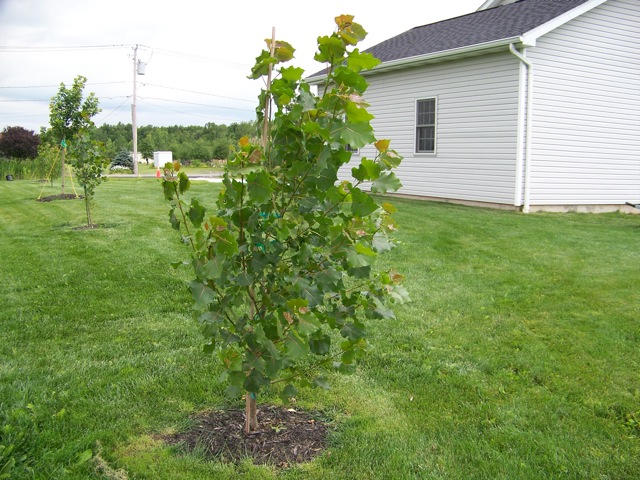
August 2009 same Hybrid Poplar
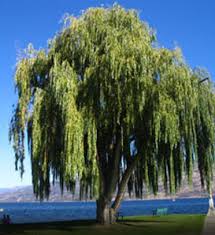
2.Weeping Willow: Depending on the cultivar weeping willow trees can grow from 3 to 8 feet per year, making it one of the fastest of the fast growing trees. Salix babylonica will grow 3 feet per year.

Weeping Willow
3.Quaking Aspen: This speedy growing tree is a member of the same family as Hybrid Poplar. It averages 2 to 3 of growth per year and adds value to any landscape because of tremendous fall color.
4..October Glory Red Maple: The fast growing red maple cultivar has been bred for brilliant fall foliage. See Julie Walton Shaver growth rate chart and pictures of her October Glory Red Maple tree from 1999 to 2006.

5.Arborvitae Green Giant: Growing up to 3 feet a year this hybrid is an exceptional landscape tree for use as a screen, hedge, windbreak, or single specimen.
6.River Birch: Known for its unique bark, fall color, and bird habitat the River Birch is also one of the fastest growing Birches. Betula nigra can grow up to 1.5 to 2 feet per year in ideal conditions.
Dawn Redwood: On good sites, its growth is rapid, with a tree in Virginia reaching 120 feet in 30 years or an average of 4 feet per year.
 e
eLeyland Cypress: This rapidly growing evergreen can easily grow 3 feet per year and has a great column shape making it an extremely popular tree in home landscape design.
Paper Birch: This extremely popular fast growing tree has been known to grow at 1.5 to 2 feet per year.
This should give you a good start to some options for fast growing trees!
If you have any questions feel free to contact us @ 281-914-7788
Wednesday, June 27, 2012
Misting Systems are perfect for the Summertime!

Misting Systems and how they benefit outdoor living!
The misting system begins with water. Water pressure is generated to reach a rating of 250-1500PSI (pounds per square inch) by using special high pressure pumps and nozzels. The water is spurted out through extreme fine nozzle openings in the pump. These water droplets are micron sized owing to the nozzle size. As a result of this, a thin mist is created around the system. This mist would evaporate immediately as it comes into contact with warm ambient air and heat. As the micron sized droplets take in heat energy along with them, the air temperature is dropped drastically. The fan in front of the system would blow the cooled air and mist for a very long distance. These systems are used for backyard patio arbors,pool areas, stables,barn areas, or private events that require some cool off for events outside in the heat.
The misting system also can introduce a misting fan that can help encourage more immediate mist cooling. These fans are special fans that can be used with water(special patent). The misting fans are highly hygienic as the water that comes out of the fans is filtered for impurities before entering the nozzles. The total amount of water used would be a maximum of about 3.8 to 7.6 liters per hour. The misting fans that come in smaller units are also available for household uses. Those who are interested in working in backyards and garages find the fans are most useful during hot summer days. Moreover they won’t need extra requirements for functioning for they are already equipped with water pumps and nozzles.
The misting system also can introduce a misting fan that can help encourage more immediate mist cooling. These fans are special fans that can be used with water(special patent). The misting fans are highly hygienic as the water that comes out of the fans is filtered for impurities before entering the nozzles. The total amount of water used would be a maximum of about 3.8 to 7.6 liters per hour. The misting fans that come in smaller units are also available for household uses. Those who are interested in working in backyards and garages find the fans are most useful during hot summer days. Moreover they won’t need extra requirements for functioning for they are already equipped with water pumps and nozzles.
I would recommend installing these systems in the hot months of the summer so that you can still enjoy your outdoor patios and garden areas.
Let us know how we can help you on this!
Feel free to contact us @ 281-914-7788 on installing these systems.
Monday, June 18, 2012
 https://www.facebook.com/pages/Arbor-Life/122161591186593
Rescue Grass!!!! How to treat it!
The other day my buddy had me over for a quick cook session and his neighbor showed me an interesting weed that grows in his Augustine! It had almost a wheat looking tail and stood very proud about 12 inches high. This weed of course looks similiar to another weed called Plantain! Well so I did some research on this weed and found some interesting info on it!!
"Rescue grass (B. catharticus), a winter annual introduced from South America into the United States as a forage and pasture grass, and smooth brome (B. inermis), a perennial native to Eurasia and introduced into the northern United States as a forage plant and soil binder, are the economically important bromegrasses"
Treatment for this weed is using a product called Olympus herbicide or ask your fertilizer rep what is an alternative since we now know the idenification of it! :)
Feel free to contact us for more information on trees,plants, and other outdoor projects!
Tuesday, January 3, 2012
Its January!!!! Check Your Trees and Plants!!!!
Since we have had this horrible summer of drought(2011), we need to do some maintenance on trees and shrubs. This a good time to do as follows:
1.Fertilization on Trees and Shrubs!---I feel it is important especially to fertilize trees during this time since sap goes dormant in the winter time. Special fertilizers are used to help our trees transition during the past drought and to get ready for future harsh weather. Aeration on tree are important at least every two years to help give oxygen,water, and fertilization down to the core of the feeder roots. Shrubs need a quick spread of triple 14. Ask us about applying these chemicals @ arborlifedesigns@gmail.com or 281-914-7788.
2.Pruning Deadwood and Looking for dead trees-It is important to be aware of dead limbs or dead trees for they can be a liability on your property and could harm you.
3.Wrap Back flows and other outdoor pipes for possible freeze! Since our cold season has started a little late this year that would be advised to be done since we might have a couple of freezes coming up.
4.Drainage-Look at possible issues in your drainage that could be affecting your sod and plants!
All these steps are important to get us ready for the spring coming up! Hope all had a great break!
Arbor Life
281-914-7788
arborlifedesigns@gmail.com
1.Fertilization on Trees and Shrubs!---I feel it is important especially to fertilize trees during this time since sap goes dormant in the winter time. Special fertilizers are used to help our trees transition during the past drought and to get ready for future harsh weather. Aeration on tree are important at least every two years to help give oxygen,water, and fertilization down to the core of the feeder roots. Shrubs need a quick spread of triple 14. Ask us about applying these chemicals @ arborlifedesigns@gmail.com or 281-914-7788.
2.Pruning Deadwood and Looking for dead trees-It is important to be aware of dead limbs or dead trees for they can be a liability on your property and could harm you.
3.Wrap Back flows and other outdoor pipes for possible freeze! Since our cold season has started a little late this year that would be advised to be done since we might have a couple of freezes coming up.
4.Drainage-Look at possible issues in your drainage that could be affecting your sod and plants!
All these steps are important to get us ready for the spring coming up! Hope all had a great break!
Arbor Life
281-914-7788
arborlifedesigns@gmail.com
Monday, October 3, 2011
Fall and Autumn Landscaping

I am soo glad the temperatures have come down! It was a hot summer and this a good time to re look at your outdoor environment! Here are some tips this Fall 2011:
1.Plants Alive??Check your existing plants and see if they are going to be replaced. There are many plants that are durable going into the winter that we can replace and will help get you ready for the holidays.
2. New Movement of older material-If you would still like to enjoy some of you most favorite summer flowers, you could transplant them in containers and bring them in every night. Or if you are not that ambitious you can cover you plants up at night to avoid the frost. Either way you are prolonging you enjoyment.
3.Specialty Color...Mums!!!Also in late summer there are a variety of mums that can be planted. These are one of the most hardy when dealing with the cold weather of October.
4.Suggestion for Color: is trees that you plant in your yard. You can go from bright yellows to fiery red. Some of the best choices are sugar maples, birch, ash ginkgo, red bud,beech, hickory, butternut, honey locust and the tulip tree just to name a few out there. Do some searching on the net. It seems like they are coming up with new hybrids every year, and you could possibly be the first on to have the new breed of tree and having the neighbors asking what kind of tree is that? Where did you get it?
5.Check Sprinklers and Dead limbs and trees: Make sure during this season you walk around your property for possible issues with your trees and turn your sprinkler on to see if zones are working property.
If you have any further questions feel free to email us at: arborlife@arborlife.com
Regards,
Arbor Life
Subscribe to:
Posts (Atom)